Sunday, April 21, 2019

Hobby: Exploring Additional Alternative Vehicles for 40k Armies


While GW makes models that are durable and fit well with their miniatures (and other 28mm/30mm/32mm "heroic scale" minis, they are not inexpensive, and have been trending towards requiring more and more time to assemble.   In the interests of variety and choice, I like to try out different options, and I like to share my findings here on the blog.


Orks:

GW's Orks in 40k  have undergone many stylistic changes, but some of my favorites were those that had a WW2 German/Afrika Korps look to them.    Like many others, I found that these models looked really good when paired up with German WW2 vehicles, specifically halftracks.

One major problem with using non-gaming model kits as gaming models is that they are often fragile, and break easily.    As I have mentioned elsewhere in the blog, I think that a gaming model needs to be durable, and quick and easy to assemble, as well as looking good and matching the scale of the miniatures it is used with.  Bonus points if it is designed in such a way that allows easy conversions.  My "gold standard" for this type of model is the classic (not current) GW Rhino, which was a modular design that had only about a dozen main parts, with a number of other accessories that allowed easy conversions, and was able to be assembled in just a few minutes.

A solution that I am thinking of for this is to use vehicles made as toys - toys for plastic army men.

***Warning:  Due to my work/commute schedule, I have not had time to paint these vehicle models yet.  If you are upset by the sight of unpainted models, stop now, and go to another post.***

Here is a 1/32nd scale Hanomag Sdkfz 251 half track from the Classic Toy Soldiers company.  It is a bit bulkier than 1/35th scale offerings, but the newer Ork sculpts are also bulkier, so it makes for a good fit.

Selling for under $20us, this half-track makes a nice econo-box transport for the Orks.


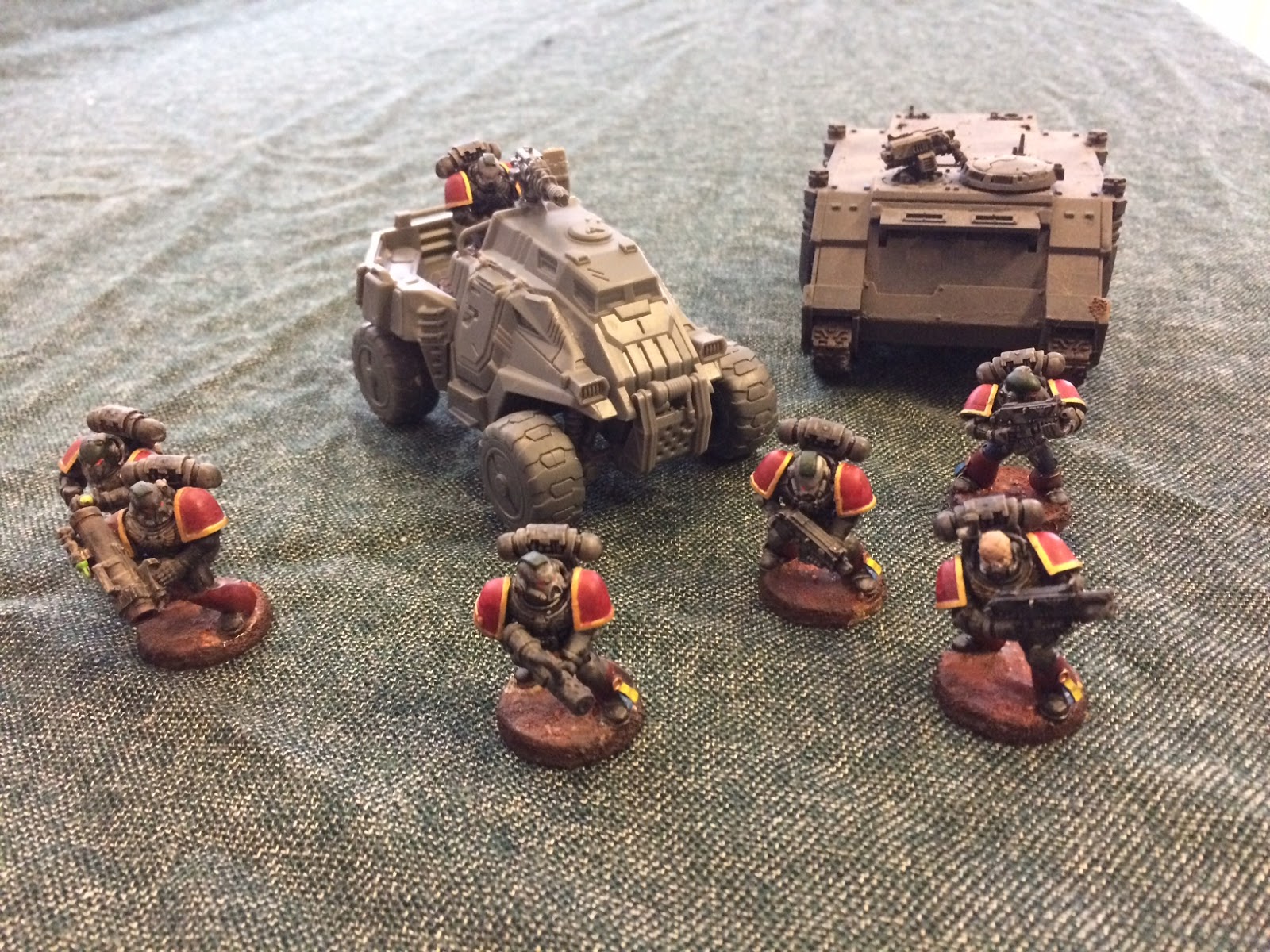
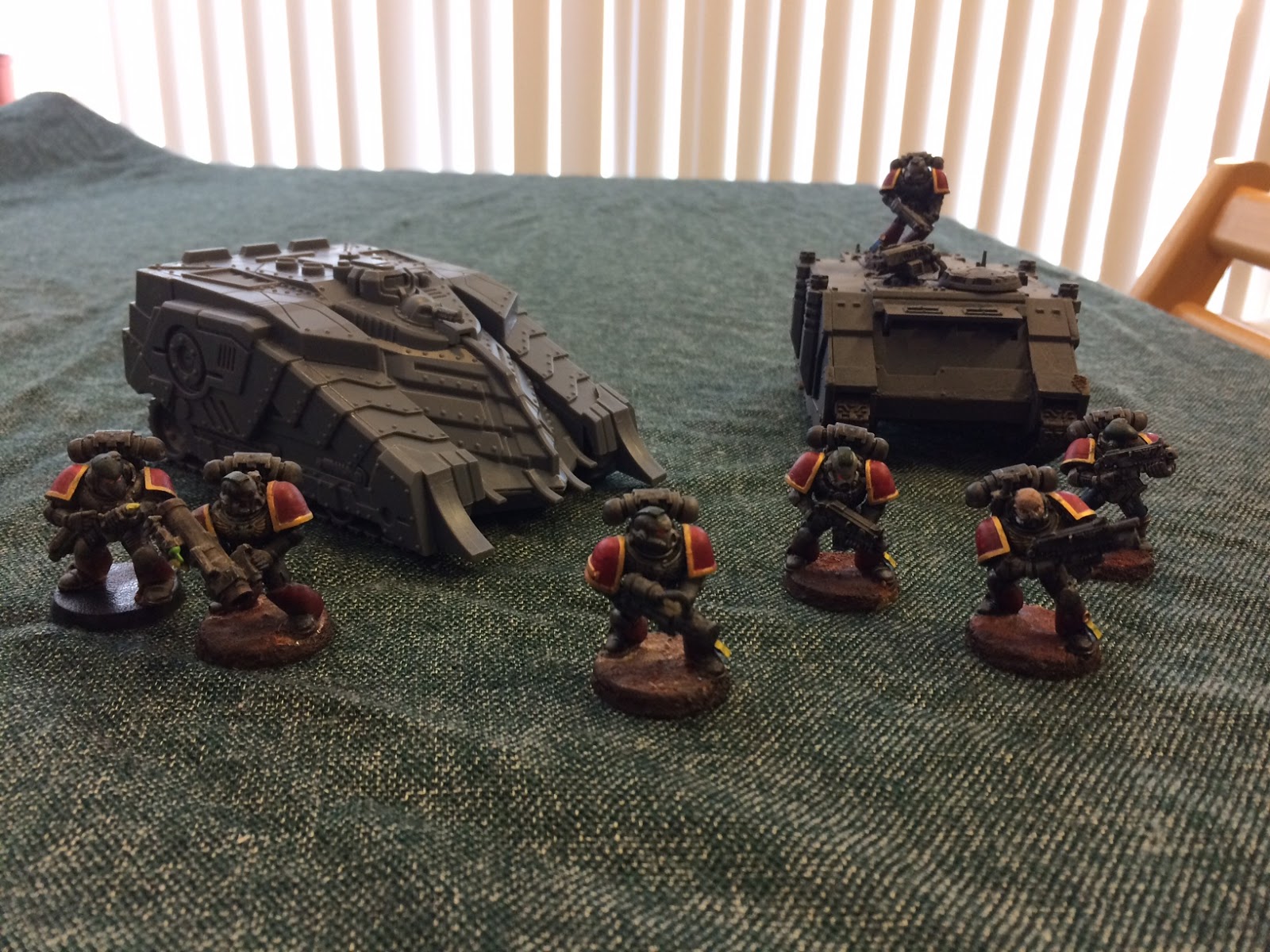
Mantic makes some nice vehicles for gaming - the ones that I have tried out are durable and fairly quick and easy to assemble.   While I do not like all of their designs, I do find some of them appealing.  I have tried a couple from their Warpath universe, and am sharing the results.   I am using my default scale reference models, GW Space Marines and a Rhino.


First up is the Mule Transport from the GCPS faction.  This is an open topped vehicle that could easily be used as a scout vehicle or utility/weapons carrier for a variety of factions.

Basically a pick up with an armored cab, the Mule is a utility vehicle that could fit into many armies.


The other vehicle I picked up from this line is the Drakkar APC, from the Forge Fathers faction.  The model is not as versatile as the Mule, but I can see it fitting in with some of the armies I build.

The Drakkar is a bit less general purpose, but could still fit in with many armies.


As always, I hope you find these helpful.

Monday, January 21, 2019

Education Commentary: What is Wrong With Allowing Students to Share the Culture of Success?


What is wrong with allowing students to share the culture of success?

As part of my teacher credential program, I was required to read an article about the importance of multiculturalism, and saying that without active support for multiculturalism, we would have “deculturalization”.   The article defined deculturalization as: “attempts to strip away the cultures of conquered peoples and replace them, through education, with European American culture”.    This definition matches the example given in the article - American Indian boarding schools of the 19th century, where children were taken from their families, punished for speaking in their native languages during their “after school” time, and even given new names by the government agents who ran their lives.  These are not practices that we see in today’s schools.  While we still attempt to ensure that our students learn English - particularly “Academic English” (since the term “Proper English” has been determined to be politically incorrect), and to be able to understand how our society works, and how to be successful within it, we actively encourage them to maintain their home languages and cultures at the same time.

In modern American schools, it could even be argued that “deculturalization” most closely describes the way that Christians and conservatives are treated – since they are told by one “multicultural expert” after another, that their culture is wrong, unimportant, and even “evil”.  This occurs at the same time that we are told to “celebrate” and “value” diversity and “multiculturalism”.   Unfortunately, our “multicultural” schools often contain monocultural students – students who are not sharing in the culture of opportunity, success, and freedom that is America’s greatest gift to her citizens.

It is great that our classrooms can reflect the many different types of people who joined together to become Americans.  What is sad is that we are often asked not to celebrate and value the shared culture that unites us as much as we promote the differences that divide us.  The strength of America has always been that, no matter where our ancestors came from, we were Americans, journeying into the future, together.

No matter where my students’ families are from, no matter what church they attend, no matter where they go on their vacations, no matter what language they speak at home, and no matter what their parents do for a living, my goal is that all of my students will be prepared to communicate, cooperate, and compete in the “mainstream” of America – to take advantages of the opportunities that our society offers,  to expand their horizons, to dream big, to have options and choices in their lives - not be relegated to pockets of poverty and failure because they can’t communicate or navigate outside of their own neighborhoods.

The only way to achieve that result is to promote a culture of success in my classroom.  The fact is that there are only two cultures that can possibly exist in a classroom: the culture of success, and the culture of failure.  A classroom can have one, the other, or a competition between the two different cultures.

I spent most of my adult life in the military, which is highly integrated and is made up of people from many different cultures, even as it is monocultural due to a shred military culture and mission. In the US military, Americans of a wide variety of backgrounds work together towards common goals.  What my experience with varied groups of students has taught me is that every student is an individual, and the only two cultures that matter in the classroom are the culture of success and the culture of failure.  Successful students share several common traits; they arrive on time, bring their materials, and are prepared to work and learn.  My goal is to have all of my students join the classroom culture of success.  This requires that students “buy in” to the classroom culture, and desire to be either successful, and/or part of the classroom culture.

The culture created and maintained in the classroom doesn’t have to be the same as the culture that the students experience in other places, such as at home.  It needs to be a culture of success, centered around learning to work together and be responsible as an individual.  The classroom culture needs to prepare students to participate in the larger American culture as they grow up, rather than restricting, limiting, and trapping them in subcultures that do not provide the same opportunities for success that exist in “mainstream” America.

Let's make sure that we raise future generations of American to celebrate not just the diversity of their families' backgrounds, but also the unifying aspects of our shared nation - and the cultural norms and traditions that will allow them to be a successful part of our shared nation and society.


Society/Politics: Commentary: Unpacking the Concept of the "Illiberal Left"

Unpacking the concept of the "illiberal left": 

The true, or "classical" liberal, has an open mind, and values free speech, even when they don’t agree with the viewpoint being professed. They rely on the competition of various viewpoints in the "marketplace of ideas" to bring forth the "true" or "best" idea, rather than trying to impose one idea or group of ideas dogmatically, and forcing everyone to accept those ideas.


lib·er·al

adjective
1.    1.
open to new behavior or opinions and willing to discard traditional values.    
2.    2.
(of education) concerned mainly with broadening a person's general knowledge and experience, rather than with technical or professional training.

1.    1.
a person of liberal views.

synonyms:
"a liberal education"

People who protest against free speech are not "liberal" at all.  A liberal should want to allow an opponent to speak - possibly allowing their own words to make them look foolish, or possibly engaging them in a discussion or debate. Using violence to shut down speech, discussion, or debate is an illiberal act. It is more in line with an authoritarian, totalitarian, or even a fascist mindset. It is certainly a tactic employed by authoritarian, totalitarian, and fascist groups throughout history - including the group whose name we all seem to love to use to label our opponents - the Nazis.

What we commonly describe as a "liberal" in our society is a person who is not at all liberal, but who is often left of the political center.

While a liberal can lean fairly hard to the left or right, they will tend to be moderate in at least some areas – and may even be to the right of center on some topics and to the left of center on other topics.

The reason that “liberal” is thrown around as an epithet is that the word has come to be associated with people who are not liberal at all, but are exceptionally narrow minded and dogmatic in their approach to political and social issues, and demand conformity of belief from those around them.  
When people are not exposed to differing viewpoints, liberalism tends to grow weak, and be replaced by dogmatic belief.  

I grew up in the SF bay area “bubble”, and like many people there, thought that most/all “smart” people thought in pretty much the same way.  I was lucky to spend a fair chunk of my adult life living in different parts of the country – parts where the people are often dismissed as “poorly educated”, “ignorant”, “reactionary”, “hicks from the sticks”. “rednecks”, “trash”,  or even “deplorables” by others in the bay area.  Yes, I lived in “flyover country”, and I discovered that many of the people I met there were smart, well-educated, sensitive, thoughtful, and good people.  Most of them did not even try to stereotype me based on where I was from, although a few seemed to think that SF and LA are right next to each other, and SF is a neighborhood/subirb of LA.

In the SF bay area, where I spent most of my life, people live in a leftist bubble – most of the viewpoints that they hear are left of center, and those who are more moderate, or even right of center, are belittled, mocked, and people who hold such views are often afraid to even speak out.  And once the diverse voices are silenced, there is no marketplace of ideas for liberals to engage in. This is why I often refer to Harvey Milk’s statements about the importance of “coming out” for the gay community, because people who learn that they have friends, family members, coworkers, or other members of their community who are gay, are forced to readdress any homophobic prejudices that they have.  Milk said that “people who know us are twice as likely to support our rights”.  The same applies to people who are moderate, center right, or even right of center - unless the other members of society know that "regular", "normal" people can have views like that, it is easy to demonize anyone who does not fall into lockstep with the illiberal leftist dogma that is prevalent in the media, politics, schools, and the public arena.

I’m guessing that one of the big reasons that conservative people from the bay area feel it is important to hold a rally is to show the rest of the community that they do exist, and that it is therefore not okay to casually and thoughtlessly dismiss and deride them at every turn.  Just as you would have to start thinking twice before casually making racist, sexist, or homophobic statements once you realize that your friends include people from each of those groups, they want you to think twice about your casual condemnation of conservatives - including Trump supporters - and the hostile atmosphere that it creates for them (including those who are not Trump fans, but voted for him because the other choices were so much worse).


The illiberal left tends to be quite Orwellian in its doctrine – engaging in “doublethink” to avoid having to accept the hypocrisy of many of their positions, hounding those who deviate from conformity for “thoughtcrime”, and even creating their own form of “newspeak” via the "Politically Correct" (PC) lexicon.    Like Big Brother, they  believe that “War is Peace” – as evidenced by their violent actions at “peaceful” protests, that “Freedom is Slavery” by their attempts to impose more and more state control over the lives of individuals, and that “Ignorance is Strength” by their repeated attempts to turn our schools, colleges, and universities into indoctrination centers, rather than institutions of learning, and by their increasingly violent attempts to suppress the free expression of any ideas that they disagree with – including actual liberals, whether left, center, or right. 


Wednesday, November 21, 2018

Hobby: From the (cold blooded) Storage Unit - Slann


When I posted pictures of my science fiction lizardmen, I got a few comments on TMP about using them as substitutes for Slann.


The Slann warband demands paint and attention!

That made me think about where my Slann might be.   During the 90s, I was lucky enough to talk a GW mail order "troll" into digging up the molds and casting me up some Slann - that was back in the day when an international phone call cost quite a bit, and there was no "web store".   After recieving the minis, I tried to get some more, but was told that the molds hade deteriorated and they weren't remastering them - since the only one who had ordered any in the past year or two was some madman from the states...   ;)      *

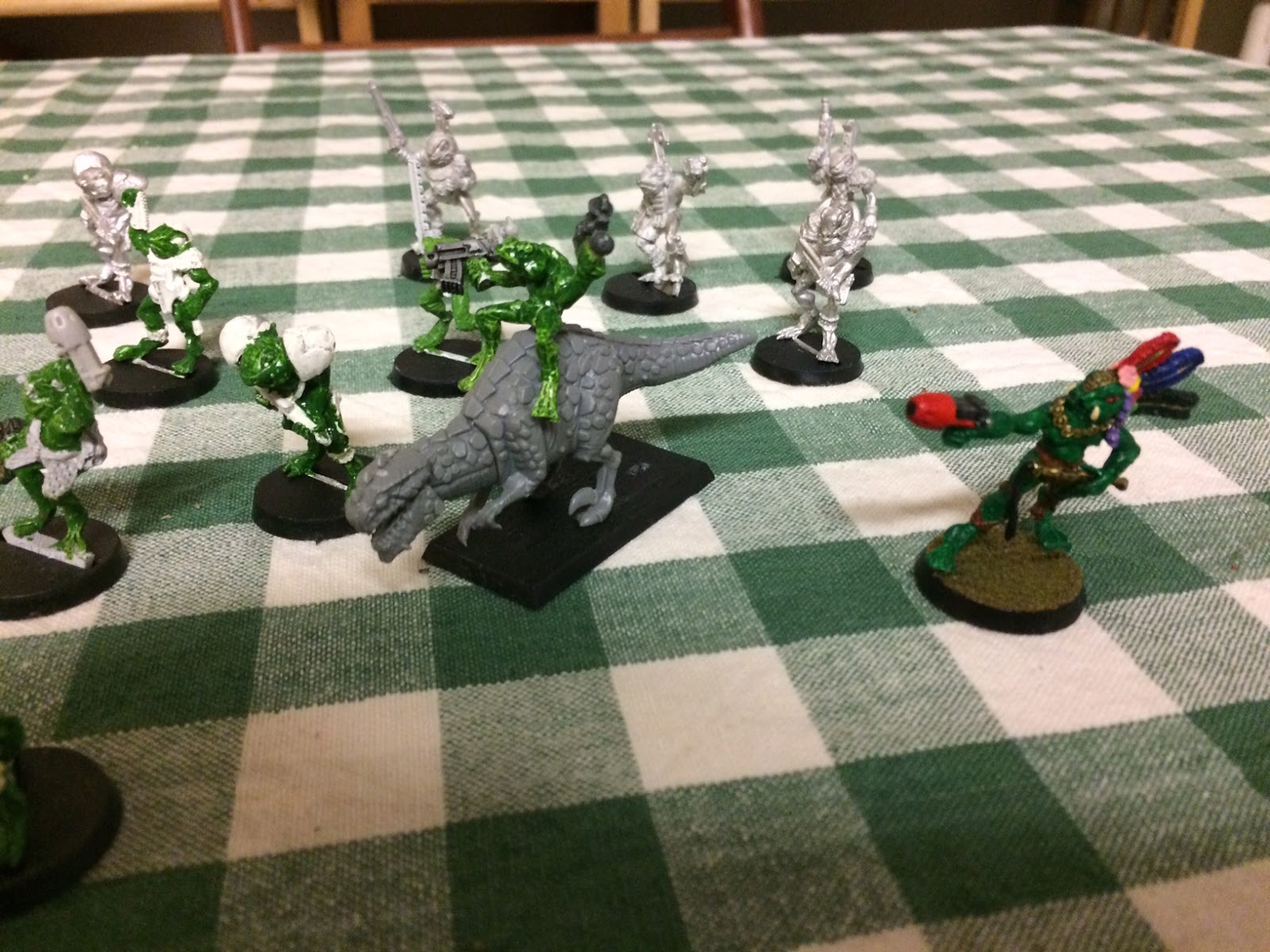
I had a chance to dig into my storage unit and found these guys from the 1990s - my Star Slann warband.  Some are primed, some have the start of a paintjob, and a few figures have more work (my test subjects).   Thankfully, these were not among the box or two of miniatures that appear to have accidentally been left in the garage of my old house when I last moved (Doh!).

A few hand weapons added to fantasy sculpts helped to flesh out the numbers.


Some are actual GW "Star Slann", while others are converted from GW fantasy Slann.


I can frog hop, or ride a cold one.


Make way for my burly lizard mount!


Cold Ones from two different eras are pictured. 

The grey plastic one is from the late 90s, either Lizardmen or Dark Elves (possibly used with both).


My lizard mount is obviously faster and more "bitey".


The painted one is from the same late 80s era as the Slann miniatures.


I will put these guys into the queue for more work, as they are minis that people find interesting.   One of the unusual things about them was that most were designed so that they could either be mounted on cold ones, or placed on slotta bases.   This gives them that "frog crouch".


Where are our brethren?   They seem to have disappeared into the mists of time.

Hope you enjoy this brief glimpse down nostalgia alley.


* This may not be the actual conversation, but it gets the essentials right - the molds were no longer usable.


Hobby: Revell's 'Halo Pelican' for tabletop gaming

Troops deploy from the rear ramp.
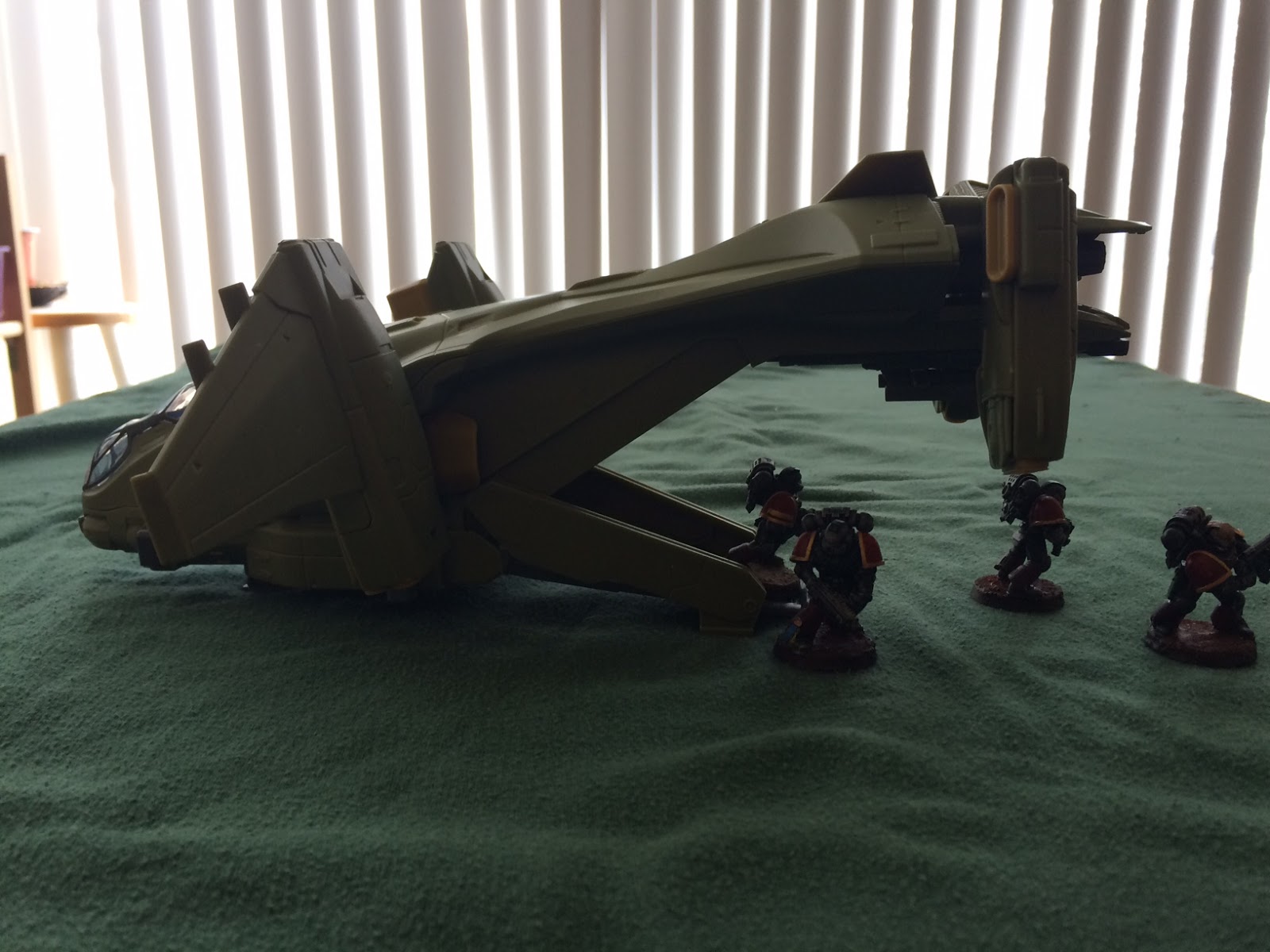
It was brought to my attention in a post on TMP (The Miniatures Page) that Revell has a "snap-tite" model kit for the "Pelican" transport from the Halo videogame universe that is reasonably priced, and, despite being modelled to a differnet scale (1:100th/15mm seems likely), works well with 28mm science fiction miniatures.   I'm sure it would work well for 15mm and 20mm as well.

I have posed it with some GW Tactical Marines and a GW Rhino for scale purposes.


The features I like about this kit include:

++  Since it is designed to be played with, and not just a static display, it is made of durable plastic.   This is a problem that I have with the Dust Tactics models - which are not very robust, despite being made for tabletop gaming.

"LZ looks clear"


Side by side with a Rhino.


Ramp is up, ready for liftoff.


+ +  Assembly takes minutes, not hours.   This has been a problem with GW vehicle kits, which moved from the original Rhino - which was a "quick to build and put on the table" model with a lot of options for simple customization - to the more recent models which feature things like multi-part tracks and take longer to assemble.


+  Landing gear and ramp are retractable.


Ramp is down.
Hot landing - watch the jet/rocket wash!
"Okay you apes - unass that lander!"


Deploy! Deploy! Deploy!


+ Parts are made in different colors, so you can get by without painting it, if you need to save time/effort.

+ Wings are movable into VTOL mode.

"Clear the ramp!  Crew wants off of this hot LZ!"


Since I am not a Halo fan (I have played a few times a few years back), I am not familiar with the way the ship is portrayed in that universe - but it seems to be large enough there to deploy small vehicles and a bunch of troops.  However, in 28mm, it still looks like it would make a credible assault transport (either from orbit, or simply atmospheric) for a single squad of troops.

You could modfiy the cockpit interior to include some 28mm crewmen, or simply make sure that the cockpit windows are dark enough that it doesn't matter.

While this is a "snap-tite" kit, I am planning to glue some of the parts together, for durability.   I will also have to decide whether or not I want to paint it, or may simply apply weathering to the colored plastic.


Sunday, November 11, 2018

Board Games: Time Warp - Notes on Running a Summer Boardgaming class (2014)

Back in the summer of 2014, I was lucky enough to get to teach a boardgaming class at the summer program where I worked.   It was popular enough that they brought the class back in future years - but unfortunately for me, I was needed tecahing other classes, so I handed it over to another staff member.

Here are the highlights of my notes, which were "GeekList" on BoardGameGeek.

https://boardgamegeek.com/geeklist/158812/teaching-modern-boardgames-teens-nine-easy-lessons


I teach at a summer day camp. The camp allows campers to choose a set of one hour classes on MWF and another set on T-Th.

This year, one of my T-Th classes is "Intermediate Strategy Games" for students entering the 6th through 9th grades. I have nine sessions with my campers, since we have the 4th of July off. I am using this Geeklist to document the process, both for my own future reference, and in order to help others who may do something similar.

My plan is to introduce a new game to all or part of the group each day - all of the group for the first two days, and then part of the group once there are a few games the others can play while I am teaching a new game to a smaller group. This means that some of my campers will finish camp having learned nine games, while others may only learn two or three, but have more experience playing those two or three games. 

I was able to pick up a nice selection of games, representing a variety of mechanics and themes, at the past few "Ding and Dent" sales at my FLGS (Black Diamond Games, in Concord, CA) in order to prepare to run this class this summer.

I will teach some games to everyone, and some games to small groups from within the class. Other games will simply be available for campers who want to read the rules and try them out on their own.

My guidelines:
Games that play in 60 minutes or less.
Games that play 4+ players.
Games that are different from other games I am bringing to the class.
Games that are reasonably available.
Games that I personally enjoy playing - since my personal attitude will be reflected in my enthusiasm for the games I am teaching.

My summer camp game box includes:
3x Carcassonne
3x Bohnanza
2x Forbidden Island
2x Saboteur
2x Maori
2x Hey That's My Fish
2x Quirkle
2x Hive
2x Mille Bornes
1x Survive! w/6 player expansion
1x Pit
1x Settlers of Catan
The camp also has several sets of chess and checkers.

I will add games to the list as each day goes by, along with any observations. Feel free to add your comments or observations about teaching these games to others - especially young people.

After the camp is over, I may open the GL to allow other BGG members to add games that they suggest for next year, or for others doing something similar.

I also wanted to include, but couldn't fit into my budget, games from the "10 Days" series.Day One:  Carcassonne
Tile Laying
Worker Placement

I started the group out with Carcassonne, since I was able to pick up three slightly smooshed copies at a good price from my FLGS.

The hardest rule to teach was that you couldn't add a meeple to a scoring feature that already has a meeple on it. I was also taken aback by the number of mismatched edge tile placements that my campers made.

We had to restart two of the three games, but they all finished before the end of the hour, and we had time to clean up.Also Day One:  Hive
Abstract
Tile Laying/Moving
Two Player

Hive is the only two player game I purchased for my campers to play. It is easy to teach - two players can share a rulebook to look up legal moves - and is good for situations where there are two campers left over from other games. Since I had two campers not playing Carc, I pulled out a copy of Hive for them and got them started. They needed me to come and remind them of a few movement rules (Only one hive!) in the first game, but needed no help for the next two.

It can also be played on the gym floor, if all the other tables are crowded.Day Two:  Bohnanza
Set Collecting
Trading

On the first day, I told the campers that since our class is at the beginning of the day, they can come in early to help me set up, and I will teach the current game to the early group. This worked out well for day two, as I taught one group the basic rules and played through two open hands before restarting them, then repeated the process with the rest of the class (three games in total).

Teaching technique: Cheat sheet/reminder about hand order, having to plant at least one card, and that any traded cards had to be planted immediately.
Had each group play at least once around the table with face up hands, then allowed them to either continue or re-start.

Modifications for first game: No 3rd field, short game/only shuffled the discard pile once.

This went smoothly, but after the learning round, all the games didn't finish early enough to get our clean up (put all tables and chairs away, because my next class is an active games class with younger campers) done before our class time ended.Day Three: Forbidden Island
Cooperative
Set Collecting

I got the early group started playing one game of Forbidden Island, and then walked another group through their first few turns.

Other campers played Bohnanza. The two who had played Hive last week played again, and then I asked them to teach the game to two campers who arrived late.

Even after I warned them of all the ways that the game could beat the team of players, both groups were surprised when they lost, and how hard the game is.

Not sure if I want to introduce a new game on Thursday (Day Four), since over half the class is still looking forward to trying Forbidden Island. Perhaps I'll sit down to a game of Carcassonne with one group on Thursday, since they seem to have taken to the other games much more readily.

Campers being able to teach others how to play games is a great sign.

I'm very happy with my decision to pick up the two copies of Hive, even though they broke my "4+ players" guideline. Not only do they work well for the extra campers, but it plays well on the gym floor, which is important since I only have three tables.Day Four: Hey That's My Fish!
Area Enclosure
Grid Movement

Today we had a "free choice" day. 

The campers grouped up on their own and played Bohnanza, Forbidden Island (two groups managed to get off the island alive today), and Hive. One keeps asking the others if they want to play chess with him - I suggested Hive, but he wanted to wait and ask the late arrivals about Chess.

I ended up teaching Hey That's My Fish! to several of the campers who were looking for a new game to try (no love for Carcassonne?).

Once again, I was happy to see the campers teaching games to each other.

The class seems to be going as planned.
Day Five:  Saboteur
Traitors
"Screwage"

Split the class into two groups and introduced them to Saboteur.

Some of them picked up on the game quite quickly, while others blundered terribly, making ridiculously bad card plays that marked them as saboteurs, even though they were not.

Quote:
Note to self: Remember, sometimes toasters pretend that they are just poor players in order to hide their toasterhood, but sometimes people on your own team are just terrible players. 

One group finished with five minutes left in our class time, and I announced that we had five minutes, and should finish up and clean up, Is it good or bad that several of them were pulling games that we've played earlier this summer out, and hoping to play them in that five minutes? 

The other great thing that I'm hearing more and more from this class is "Where can I get a copy of this game?"
Day Six:  Survive
Throwing People Under the Bus
Sound Effects

Taught Survive to one group today, while the others got to choose from the games they've already learned. 

"Is this going to be another coop game?" one camper asked, while trying to decide whether to learn Survive or play another game. 
"No" I replied, "It's just about the opposite. IN this game you not only get to compete, but you get to throw your opponents under the bus - figuratively speaking. What you really do is feed them to the sharks and sea serpents."
"Cool! I am playing this one!"

The campers failed to buy-in to my suggestion that they make screaming noises whenever one of their meeples was devoured - but thought it was funny when I did it.

They did join me in chanting "shark, shark, shark!" or "Sea monster, sea monster!" when someone was rolling the die, and made Jaws theme music whenever a shark was being moved.

The group also learned the term "AP" (Analysis Paralysis), since one camper kept having trouble deciding whose juicy meeples he wanted to feed to the sharks. 

Day Seven:  Multiple Games
Table Talk
Sportsmanship/Spirit of the Game

Taught Survive to another group. We went into the concept of "table talk" - pointing out moves that could destroy other people and divert from your own, "trash talking", using diversion, etc.

We also talked a bit about how it is okay to be absolutely ruthless in a game - even against your best friends - as long as you can go back to your regular self after the game.

Other campers played games they'd previously learned - including Carcassonne.It's nice that I've reached the point in the class that I can sit down and play a game with a group of campers, and talk about these "teachable moments" as they come up naturally in the games.

The first few days I had to keep rotating around and showing/telling/explaining rules - now I can talk to them about gaming concepts and strategies.


Day Eight:  Maori

Handicaps
Rulebooks

Taught one group to play Maori, which they really enjoyed. Although everyone used the same side of the board, and the same rules, I explained how the game allows you to handicap some players (individual boards and optional restrictions on tile placement).

Some of the campers don't believe that I can remember most of the rules for a game unless I've played it in the last few weeks. Others are surprised when I look up rules, and correct myself. Took the opportunity to show them how to look for things in a rulebook - common organization like "setup information" at the front, and "Game end/scoring information" at the back.

Day Nine:  Multiple Games

Having Fun
Next Steps

I taught Maori to another group today, and then started moving from table to table, and checking in with the different groups. One group wanted to try some of the optional, advanced rules for Maori, so I helped them with that. They then started coming up with ideas for variant house rules.

Survive had a full table, and Carcassonne, Forbidden Island, and Bohnanza also saw more play today.

Most of my campers asked if they will be able to take the class again next summer.

I hope this list helps other educators to plan successful gaming clubs or classes of their own.

One of my greatest disappointments with the way I ran this class was that I was unable to include any games by Friedemann Friese, who is one of my favorite designers (I know that this entry makes me guilty of blatant/shameful fanboyism). 

A lot of his games are out of print, Power Grid takes longer than an hour, Friday is a solitaire game...

Felix The Cat in the Sack almost made it, and was in my initial plan, but I couldn't get the extra copies I needed (I have given all my extras away as gifts).

Still, I dedicate this list to Mr. Friese, because he is the one who inspired me to teach a boardgaming class. In a "bull" session at my FLGS, I once commented that, since each of his designs focuses on a different mechanic, and since he has so many varied games, that teaching a modern boardgaming class, or a game design class, could probably be done using just FF games. From that idle conversation came the thought of actually teaching a boardgaming class - which I have now done. 

Saturday, November 10, 2018

Hobby: November - Works in Progress

I haven't posted any hobby things for a while, so I thought I'd share a few projects where I have made some progress.

I've basecoated the model rocket in white, and added some weathering (sat it in tea).   Not sure if I'm going to do much more, since the stark look reminds me of NASA spacecraft.  I will probably add some identifying numbers (maybe use some of those model airplane transfers that have been in storage forever?) and some clear plastic to the viewports.

I've also done some work on my mixed "Space Lizards" - I think I may eventually add some actual "Star Slann" to the mix.


Here are some closer pics of the "Space Lizards"


These models still need some finishing touches, along with work on the bases.

They are close to "table ready" - where they only have to look great from about two or three feet away.  ;)


The Rocket Ship is from Green Toys   http://www.greentoys.com/green-toys-rocket


The Lizards are a mix of GW Plastic Lizardmen from the late 1990s, and  Garn miniatures from Khurasan miniatures 28mm Sci-Fi line, with some conversions using GW bitz.
http://khurasanminiatures.tripod.com/28mmscifi.html


I have started a new job, so have been very busy with that transition.   One of the cool things about the new position is that in the spring term, I may be able to host a weekly games night at the school.