Sunday, September 1, 2019

Hobby: The missing summer posts - experimenting with "Contrast" paints


I started some posts this summer, but had some camera/phone problems (my phone's battery was swelling as it got older, and started pushing the phone apart, so I had to replace it) and never got the posts finished or posted.

It's a long weekend, so why not play catch-up?

GW introduced a new line of paints this summer called "Contrast".   These are supposed to be both a paint and a wash, all in one.   I decided to try some out, as the idea behind them is to reduce painting time for "table ready" (as opposed to "painting competition ready") models.   Those of you who know me know that I am a slow painter, have shaky hands, and can come up with a bunch of excuses that keep me from getting painting done, and I am certainly not a competition level painter.

I started out with the new Ambull from Blackstone Fortress.  I primed her with burnt umber, and used the camo green contrast paint over it, and like the results.


The model needs a bit more work, including basing, before it's finished.  Still, it allowed me to try out the colors I was able to get in July.   My ADD forced me to move along to another project. ;)


I moved on to work with some Cold Ones - giant lizards that various troops may use as mounts.   I like the results I achieved with these guys.


Then I decided to spruce up some of  my "old school" Space Hulk Terminators, in case I get a houseguest that wants to play a few rounds.


And then, of course, I tried out some of the contrast paints on the genestealers.   The darker blue looks better in person than in these pictures, but I want to find a better paint scheme before I finish off the pile of unpainted  'stealers that has been threatening to devour my home for decades.


I was a bit disappointed at how thin the purple ended up being - I was hoping for it to be more robust.  I may have to use a different primer for the rest of them.


I also touched up a few Chaos Androids (originally from the GW/Milton Bradley crossover "Space Crusade"), thinking they will be useful to replace the cardboard tokens in "Space Marine Adventures: Labyrinth of the Necrons" (another 40k boardgame).


Changing pace....
As you can see on the front model, the contrast paints can sometimes leave a spotty finish.

Then I went to work on some of the multitudes of unpainted space marine models that live in the walk-in closet of my guest bedroom.   These started out primed white, which is not recommended for contrast paints, as I was working on matching a paint/wash combo I had used on a squad of Space Marines from the game-changing (and great) 3rd Edition 40k box set back in 1999/2000, but packed away due to the divorce, several moves, and change of career.  One problem I have had matching the painting scheme I used back then is that GW has changed their paints multiple times since then.  With the white primer, I used the darker of the gray/black contrast paints, and sometimes used two coats.

The idea behind these models was to have a gritty, "in the field" look, as well as being easy to paint.   Many 40k armies - particularly space marines - are known for bright (even gaudy) colors.   I wanted something that looked more lived in, but kept the color accents (blood red and gold/brass/bronze*).

* Depending on what metallic colors I had available at the time I painted each batch of models.

Some of the early missile launcher models.

Missile Launchers continue to be my favorite SM heavy weapon.

A variety of missile launchers.  The one at center front is the most recent, and I included it for that reason, even though I haven't painted its shoulder pad trim yet.


Some multi-meltas and a heavy bolter.


Sometimes a las-cannon is the right tool for the job.


Assault squad with jump packs.


Heroes abound in the space marines.


Some space marine "riflemen" with bolters.


This group features a couple of Mk 6 "Beakie" marines from the RTB-01 box set - the first plastic 40k minis - along with their more modern brethren.


In this case, I used the contrast paints to spice up a squad I had block painted back in the 1990s.


The contrast paints add more texture to the look of the models.


Hobby: "Beastie Boys" - Blackstone Fortress Beastmen: work in progress

I apologize for the long interlude without posting.   As a teacher, I should be able to get so much hobby stuff done in the summer, and yet...


... here we are.


I liked the beastmen in the Blackstone Fortress game so much that I picked up a few more on e-bay.


One nice thing about them is that they are quick and easy to assemble.   They have four pieces - legs, a torso front, a torso back, and a head, and there are two versions of each piece.   This means that they also only have a limited number of unique poses, which is not a problem if you are just using the four that come with a single Blackstone Fortress set, but opens up some quick conversion opportunities if you want to put together larger units (herds?) of them.  I am not overly fond of the running legs, as they only allow one point of connection to the base, but there are certainly models out there that are more awkward.


I think I've managed to get 20 unique minis, using some simple weapons swaps.   The most basic were putting the torsos together so that some had two melee weapons and others had two handguns.  Also pretty basic was swapping out the chainsword for the blade. 

A dip into the bitz box gave me access to some Chaos Warriors bitz, like a cloak for my leader, axes, a Chaos sword, and some flails.  I then added in some weapons left over from Genestealer Cult, Cadian, and Space Marine kits: different las-pistols, bolters, plasma pistols, and flamers (because low Ballistic Skill troops like Beastmen would want to have template weapons) and ended up with what you see here.


As you can see, the models have been primed, but not painted.   I added basing to a few of them to hide extra plastic I used to help stabilize the single foot (and one with both feet on the ground because I wasn't paying attention, grabbed the next model, and added basing material).


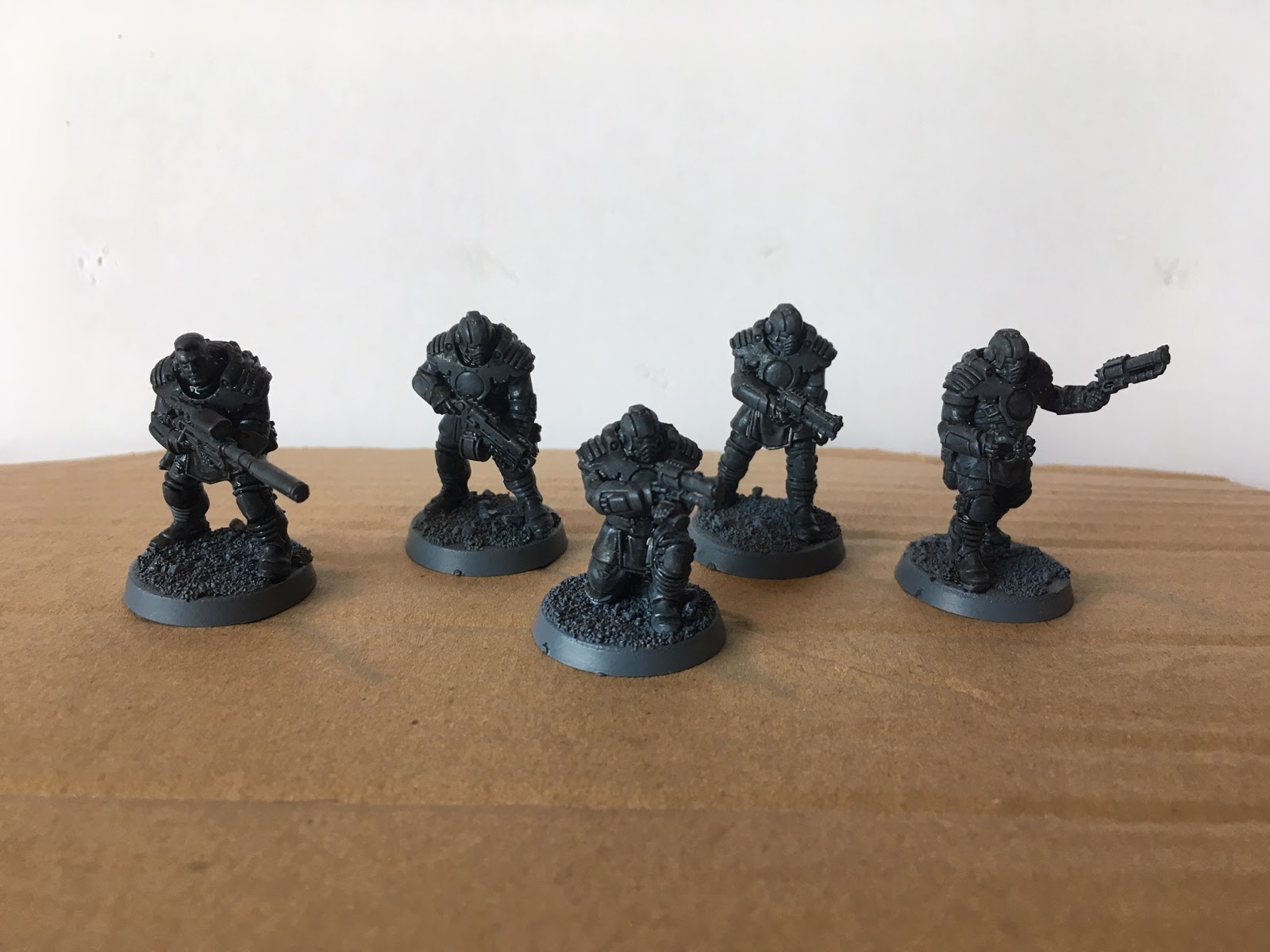
Contrast these with the Necromunda Palanite Enforcers released late this summer - here is my preliminary review of them, produced as I started building them.
The Enforcer models look nice.

They are humans in body armor that would seem to fit nicely with several lines of "heroic 28mm" human figures, and can work for police, security, paramilitary, and other roles.
They are multi-part models.
There are accessories, such as ammo pouches, grenades, holstered handguns, even handcuffs.


The box comes with two identical sprues, so there are extras of some things, which can go into your bitz box for use with other models.


These are GW plastic models, so are hard plastic, can be glued with plastic glues (super glue is not required), and can be cut cleanly for simple conversions.
The disappointing:
The sprues are crowded and tight – it can be difficult to get your side cutters into position to cut the pieces out.

The models, despite being multi-part, have limited build options.
There are a lot of parts for each model, particularly when you consider that they are designed so that each body needs to have a matched torso set (front and back), matched legs (matched with each other, and the torso), and appears to require a matched set of arms (matched with each other and the torso – but these are likely to be the easiest to mix and match).
Each model has a head, torso front, torso back, neck (?), right leg, left leg, right arm, left arm, right hand and left hand – ten matched parts for the basic body, then more to add equipment. One figure requires an additional part for the lower front portion of the tunic.

Much more fiddly than you might expect for minis that are not really multi-pose – by comparison, many GW kits (such as Cadians) have head, torso (one or two piece), legs, and right and left arms (sometimes with hands attached), and legs, a total of 5-8 body pieces, plus equipment, and allow a greater variety of poses.
Half a box of Enforcers.  Primed and blackwashed for the photo.


I think that the models will be useful in a variety of roles for me, but am not rushing out to buy several more boxes (as I was thinking of when I first saw these minis), since the same ten minis (five poses, each with two weapons options) will be repeated, and building them is not as fun as building other minis – such as SM tactical squads, orks, or Cadians.

Sunday, April 21, 2019

Education Commentary: Is It Time to Rethink the Standard Grading Rubric?

Is it Time to Rethink the Standard Grading Rubric?

In recent years, there has been a push to force teachers to engage in practice of giving away grades to students who have done nothing to earn them.  The push is to have teachers give students a 50% even if the student makes no effort, and turns nothing in.


Let’s let that sink in.   50% for doing nothing – no progress, no learning, and no effort.   


Obviously, there is a reason that otherwise rational and reasonable people would  push teachers to engage in such behavior.   The questions that come to mind are why would something like this be needed, and is this the best way to address it?


Why is it needed? 
There seems to be a growing realization that the “standard grading rubric” which requires students to earn 60% of the total points to earn a “D”, 70% to earn a “C”, 80% to earn a “B”, and 90%+ to earn an “A”, is not working in the way it was intended to – to show progress towards mastery of a subject.


In the sport of baseball, professional players – the top people in their field, with years of experience, are supposed to hit a baseball when it is pitched to them.   This is a basic part of their job.   If they get it right 40% of the time, they will be in the Hall of Fame.   


Meanwhile, if a student, who is learning something new, gets it right 59.99% of the time, they fail.


An NFL quarterback who gets it right less than that still earns millions of dollars – and can even successfully sue if they are fired for that level of performance (Colin Kaepernick won only 48% of his games, and completed only 59% of his passes, and successfully sued for not being kept on the team).


In the process of learning a new skill, you will fail many times before you succeed, and even after your first success, you will still have to work and practice to improve your performance (and may never achieve perfection).


Yet a student learning a new subject “fails” if they are not able to maintain at least a 60% average on their attempts to work towards mastery of it.  Even if you weight the final assessment much higher than the earlier attempts, you are setting the student up for failure.


There’s a problem there.


So the next question is: Is giving 50% to those who don't even try actually an appropriate way to address it?


Giving half credit for not doing anything is not the solution – in fact, it is counterproductive and harmful.  It teaches students many wrong lessons – that laziness and lack of effort are worthy of reward, that points and grades are "given" by teachers, rather than being earned by students, and that it is not important or necessary to put any effort into school and learning.     Woody Allen famously said that “90% of life is just showing up”, yet teachers are being pushed to give 50% credit to students who effectively don’t even bother to “show up” – students who make no effort, and turn nothing in.


I understand that getting an extremely low score can put a student in a place where it is difficult (or even impossible) for them to bring the grade up, and I will often create a grading scale where students earn a minimum of 50% for putting in the effort – but the student has to actually make an effort in order to earn that 50% - just as in real life, there are no free points for doing nothing.  But that is not good enough for those who demand that kids be given 50% credit for doing nothing and making no effort.


So let's rethink this.  Instead of giving away 50% for doing nothing, why not simply adjust the rubric?  


In other words, if you are giving half the points for doing nothing, then why not just subtract that bottom 50% from the total?   So instead of giving an unearned gift of 500 of 1000 points to a student who does nothing, makes no effort, and makes no progress towards learning, because you are worried that it will make it impossible for them to dig themselves out of the "F hole" by doing other assignments, just adjust the rubric  to make the "F hole" less deep.


Instead of giving away 50% credit to those who do nothing, why not just take the bottom 50% of the points off for everyone?  In other words, adjust the rubric so that 20% earns a “D”, 40% earns a “C”, 60% earns a “B”, and 80% earns an “A”. 


Or, we could keep stringent requirements for “A”s and “B”s at 90% and 80%, but have broader percentage ranges for “C”s and “D”s, giving us a standard grading rubric of 20% for a “D”, 50% for a “C”. 80% for a “B”, and 90% + for an “A”.


Adjusting the “standard grading rubric” is an ethically correct way to do this.   Pressuring teachers to give away 50% credit for doing nothing is unethical, dishonest, unprofessional, and harmful, and it needs to stop.


One Possible Solution:
We need to simply get rid of the "standard grading rubric" and move to a "progress towards mastery" grading/tracking system.

Keep in mind that "mastery" doesn't always mean 100% or even 90% success.

I'm not a baseball fan, but I know that a MLB player is a trained expert and has achieved mastery in their field, with years of experience. They are paid millions of dollars to do the job that they have focused on for the years of training and apprenticeship. Yet if they are successful in hitting the ball and getting on base just 40% of the time (.400 batting average), they are likely to end up in the hall of fame. Even a 30% success rate (.300 batting average) is considered good (with league average percentages in the 20s).

So we need to accept the fact that, for some tasks, a success rate as low as 25% could be considered "mastery", and base our grading system accordingly.  Sure, other tasks will require a higher success rate for mastery, and it should be the job of teachers - not bureaucrats - to determine what that level should be.

But not even trying is always going to be a zero, and always needs to be graded as a zero, and any "educator" or bureaucrat who demands that credit should be given when no work is accomplished  - or even attempted - needs to be removed from a position where they can influence educational policy.

Hobby: Low Profile Space Marine Color Schemes


Recently, there was a discussion thread on TMP (The Miniatures Page) regarding Space Marine armor in the 40k universe.  "Back in the day" (as we old-timers are known to say), GW had much more of a stylistic variety in how they depicted SM armor - even supporting the idea that the armor suits had the ability to change between mulitple color schemes.

While I think that the overly colorful style of painting featured by the GW 'Eavy Metal team is too pretty for anything less than a recruiter's dress uniform (or Napoleonics), I will admit that they are eye catching, show off great painting techniques, and probably help to sell models. Still, I think that the "dark future" should be more "gritty and grimy" than "bright and shiny".

Over the years, I have gone back and forth on color schemes for armor, but prefer those that are more subdued, and certainly grimy and worn looking.

Camouflage can be difficult to paint if you try to make the pattern on each figure match perfectly - my painting skills are not up to that level.  Here I have a group of miniatures, from a variety of manufacturers , and a variety of GW styles, with similar camo patterns.  You can judge for yourself how well they fit in with each other.

Metal Magic, Steel Legions, a variety of GW Space Marines, and a few RAFM Reaction Marines.


More recently, I have experimented with a more grimy color scheme, with some "colorful" accents that are more in keeping with "normal"/"popular" space marine painting schemes.  Even with the dark and dirty gray/black body armor, I went with "colorful" - if subdued - red pauldrons and greaves and added a gold accent trim to the pauldrons.  To add more touches of color, I painted the purity seals in blue and yellow (which is also easier to paint than the parchement look I started with).


Here is my compromise between a realistic combat uniform look, and a showy dress uniform look.
What are your thoughts on how colorful Space Marine armor should be?

Hobby: Exploring Additional Alternative Vehicles for 40k Armies


While GW makes models that are durable and fit well with their miniatures (and other 28mm/30mm/32mm "heroic scale" minis, they are not inexpensive, and have been trending towards requiring more and more time to assemble.   In the interests of variety and choice, I like to try out different options, and I like to share my findings here on the blog.


Orks:

GW's Orks in 40k  have undergone many stylistic changes, but some of my favorites were those that had a WW2 German/Afrika Korps look to them.    Like many others, I found that these models looked really good when paired up with German WW2 vehicles, specifically halftracks.

One major problem with using non-gaming model kits as gaming models is that they are often fragile, and break easily.    As I have mentioned elsewhere in the blog, I think that a gaming model needs to be durable, and quick and easy to assemble, as well as looking good and matching the scale of the miniatures it is used with.  Bonus points if it is designed in such a way that allows easy conversions.  My "gold standard" for this type of model is the classic (not current) GW Rhino, which was a modular design that had only about a dozen main parts, with a number of other accessories that allowed easy conversions, and was able to be assembled in just a few minutes.

A solution that I am thinking of for this is to use vehicles made as toys - toys for plastic army men.

***Warning:  Due to my work/commute schedule, I have not had time to paint these vehicle models yet.  If you are upset by the sight of unpainted models, stop now, and go to another post.***

Here is a 1/32nd scale Hanomag Sdkfz 251 half track from the Classic Toy Soldiers company.  It is a bit bulkier than 1/35th scale offerings, but the newer Ork sculpts are also bulkier, so it makes for a good fit.

Selling for under $20us, this half-track makes a nice econo-box transport for the Orks.


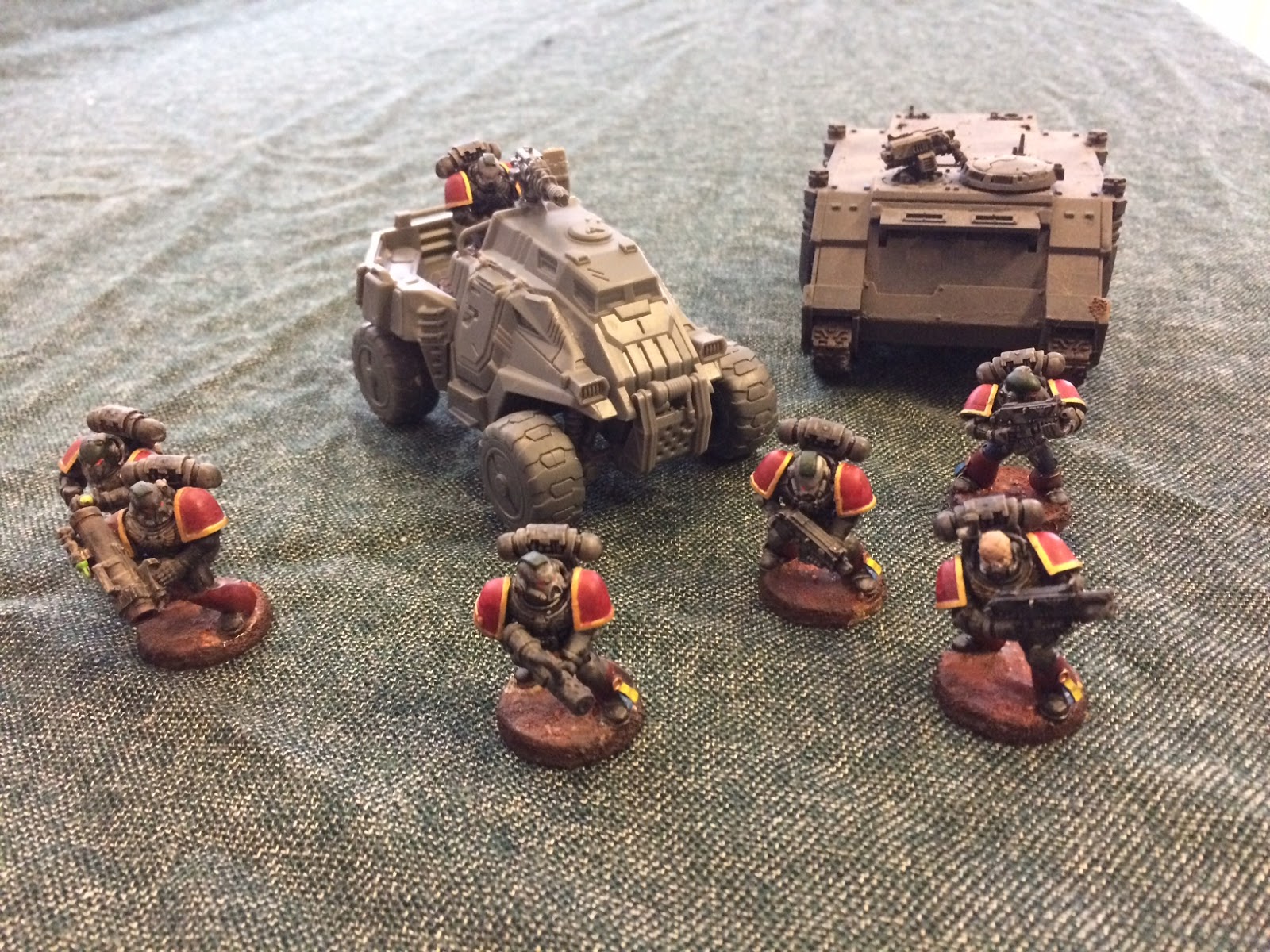
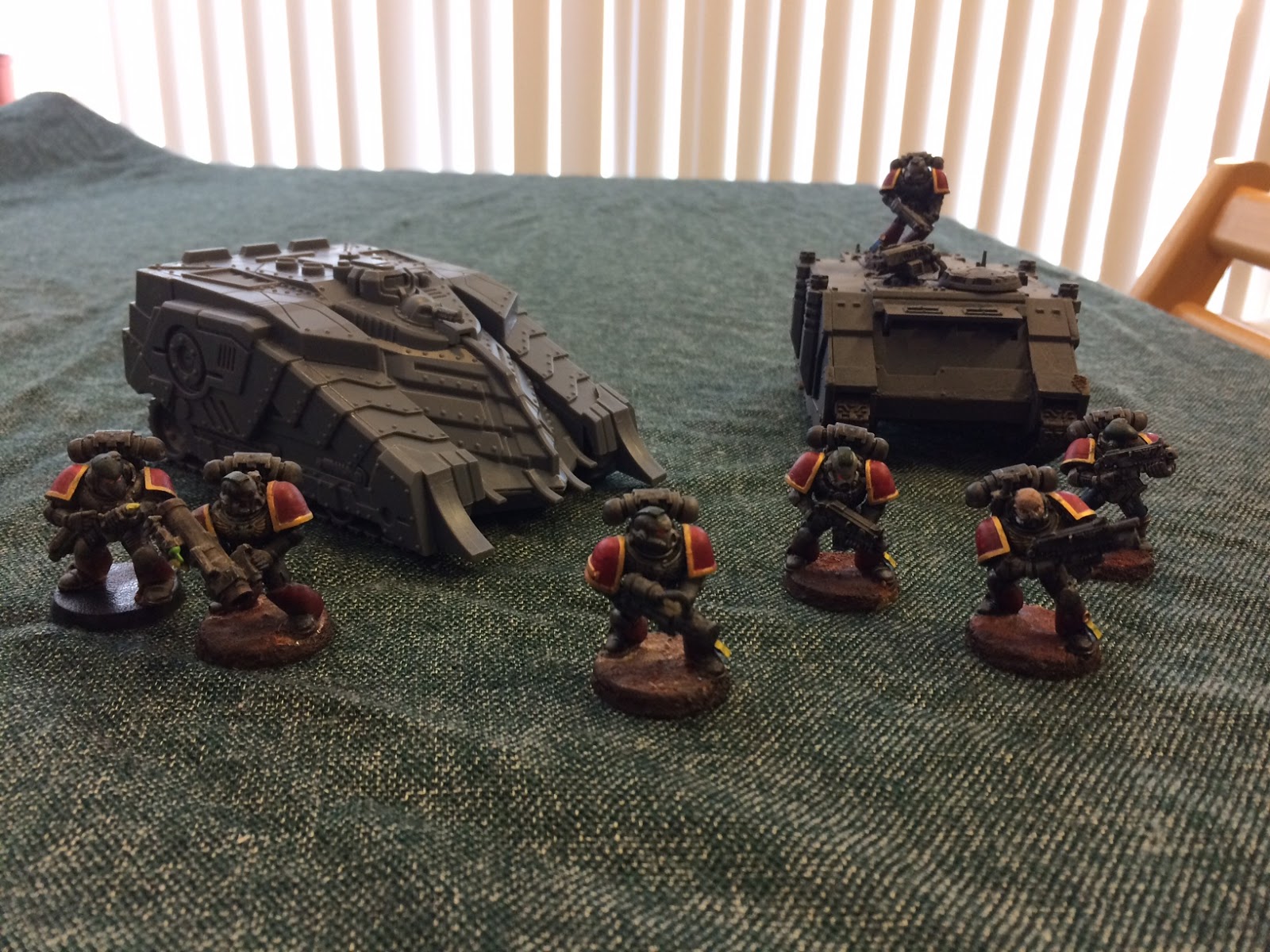
Mantic makes some nice vehicles for gaming - the ones that I have tried out are durable and fairly quick and easy to assemble.   While I do not like all of their designs, I do find some of them appealing.  I have tried a couple from their Warpath universe, and am sharing the results.   I am using my default scale reference models, GW Space Marines and a Rhino.


First up is the Mule Transport from the GCPS faction.  This is an open topped vehicle that could easily be used as a scout vehicle or utility/weapons carrier for a variety of factions.

Basically a pick up with an armored cab, the Mule is a utility vehicle that could fit into many armies.


The other vehicle I picked up from this line is the Drakkar APC, from the Forge Fathers faction.  The model is not as versatile as the Mule, but I can see it fitting in with some of the armies I build.

The Drakkar is a bit less general purpose, but could still fit in with many armies.


As always, I hope you find these helpful.

Monday, January 21, 2019

Education Commentary: What is Wrong With Allowing Students to Share the Culture of Success?


What is wrong with allowing students to share the culture of success?

As part of my teacher credential program, I was required to read an article about the importance of multiculturalism, and saying that without active support for multiculturalism, we would have “deculturalization”.   The article defined deculturalization as: “attempts to strip away the cultures of conquered peoples and replace them, through education, with European American culture”.    This definition matches the example given in the article - American Indian boarding schools of the 19th century, where children were taken from their families, punished for speaking in their native languages during their “after school” time, and even given new names by the government agents who ran their lives.  These are not practices that we see in today’s schools.  While we still attempt to ensure that our students learn English - particularly “Academic English” (since the term “Proper English” has been determined to be politically incorrect), and to be able to understand how our society works, and how to be successful within it, we actively encourage them to maintain their home languages and cultures at the same time.

In modern American schools, it could even be argued that “deculturalization” most closely describes the way that Christians and conservatives are treated – since they are told by one “multicultural expert” after another, that their culture is wrong, unimportant, and even “evil”.  This occurs at the same time that we are told to “celebrate” and “value” diversity and “multiculturalism”.   Unfortunately, our “multicultural” schools often contain monocultural students – students who are not sharing in the culture of opportunity, success, and freedom that is America’s greatest gift to her citizens.

It is great that our classrooms can reflect the many different types of people who joined together to become Americans.  What is sad is that we are often asked not to celebrate and value the shared culture that unites us as much as we promote the differences that divide us.  The strength of America has always been that, no matter where our ancestors came from, we were Americans, journeying into the future, together.

No matter where my students’ families are from, no matter what church they attend, no matter where they go on their vacations, no matter what language they speak at home, and no matter what their parents do for a living, my goal is that all of my students will be prepared to communicate, cooperate, and compete in the “mainstream” of America – to take advantages of the opportunities that our society offers,  to expand their horizons, to dream big, to have options and choices in their lives - not be relegated to pockets of poverty and failure because they can’t communicate or navigate outside of their own neighborhoods.

The only way to achieve that result is to promote a culture of success in my classroom.  The fact is that there are only two cultures that can possibly exist in a classroom: the culture of success, and the culture of failure.  A classroom can have one, the other, or a competition between the two different cultures.

I spent most of my adult life in the military, which is highly integrated and is made up of people from many different cultures, even as it is monocultural due to a shred military culture and mission. In the US military, Americans of a wide variety of backgrounds work together towards common goals.  What my experience with varied groups of students has taught me is that every student is an individual, and the only two cultures that matter in the classroom are the culture of success and the culture of failure.  Successful students share several common traits; they arrive on time, bring their materials, and are prepared to work and learn.  My goal is to have all of my students join the classroom culture of success.  This requires that students “buy in” to the classroom culture, and desire to be either successful, and/or part of the classroom culture.

The culture created and maintained in the classroom doesn’t have to be the same as the culture that the students experience in other places, such as at home.  It needs to be a culture of success, centered around learning to work together and be responsible as an individual.  The classroom culture needs to prepare students to participate in the larger American culture as they grow up, rather than restricting, limiting, and trapping them in subcultures that do not provide the same opportunities for success that exist in “mainstream” America.

Let's make sure that we raise future generations of American to celebrate not just the diversity of their families' backgrounds, but also the unifying aspects of our shared nation - and the cultural norms and traditions that will allow them to be a successful part of our shared nation and society.


Society/Politics: Commentary: Unpacking the Concept of the "Illiberal Left"

Unpacking the concept of the "illiberal left": 

The true, or "classical" liberal, has an open mind, and values free speech, even when they don’t agree with the viewpoint being professed. They rely on the competition of various viewpoints in the "marketplace of ideas" to bring forth the "true" or "best" idea, rather than trying to impose one idea or group of ideas dogmatically, and forcing everyone to accept those ideas.


lib·er·al

adjective
1.    1.
open to new behavior or opinions and willing to discard traditional values.    
2.    2.
(of education) concerned mainly with broadening a person's general knowledge and experience, rather than with technical or professional training.

1.    1.
a person of liberal views.

synonyms:
"a liberal education"

People who protest against free speech are not "liberal" at all.  A liberal should want to allow an opponent to speak - possibly allowing their own words to make them look foolish, or possibly engaging them in a discussion or debate. Using violence to shut down speech, discussion, or debate is an illiberal act. It is more in line with an authoritarian, totalitarian, or even a fascist mindset. It is certainly a tactic employed by authoritarian, totalitarian, and fascist groups throughout history - including the group whose name we all seem to love to use to label our opponents - the Nazis.

What we commonly describe as a "liberal" in our society is a person who is not at all liberal, but who is often left of the political center.

While a liberal can lean fairly hard to the left or right, they will tend to be moderate in at least some areas – and may even be to the right of center on some topics and to the left of center on other topics.

The reason that “liberal” is thrown around as an epithet is that the word has come to be associated with people who are not liberal at all, but are exceptionally narrow minded and dogmatic in their approach to political and social issues, and demand conformity of belief from those around them.  
When people are not exposed to differing viewpoints, liberalism tends to grow weak, and be replaced by dogmatic belief.  

I grew up in the SF bay area “bubble”, and like many people there, thought that most/all “smart” people thought in pretty much the same way.  I was lucky to spend a fair chunk of my adult life living in different parts of the country – parts where the people are often dismissed as “poorly educated”, “ignorant”, “reactionary”, “hicks from the sticks”. “rednecks”, “trash”,  or even “deplorables” by others in the bay area.  Yes, I lived in “flyover country”, and I discovered that many of the people I met there were smart, well-educated, sensitive, thoughtful, and good people.  Most of them did not even try to stereotype me based on where I was from, although a few seemed to think that SF and LA are right next to each other, and SF is a neighborhood/subirb of LA.

In the SF bay area, where I spent most of my life, people live in a leftist bubble – most of the viewpoints that they hear are left of center, and those who are more moderate, or even right of center, are belittled, mocked, and people who hold such views are often afraid to even speak out.  And once the diverse voices are silenced, there is no marketplace of ideas for liberals to engage in. This is why I often refer to Harvey Milk’s statements about the importance of “coming out” for the gay community, because people who learn that they have friends, family members, coworkers, or other members of their community who are gay, are forced to readdress any homophobic prejudices that they have.  Milk said that “people who know us are twice as likely to support our rights”.  The same applies to people who are moderate, center right, or even right of center - unless the other members of society know that "regular", "normal" people can have views like that, it is easy to demonize anyone who does not fall into lockstep with the illiberal leftist dogma that is prevalent in the media, politics, schools, and the public arena.

I’m guessing that one of the big reasons that conservative people from the bay area feel it is important to hold a rally is to show the rest of the community that they do exist, and that it is therefore not okay to casually and thoughtlessly dismiss and deride them at every turn.  Just as you would have to start thinking twice before casually making racist, sexist, or homophobic statements once you realize that your friends include people from each of those groups, they want you to think twice about your casual condemnation of conservatives - including Trump supporters - and the hostile atmosphere that it creates for them (including those who are not Trump fans, but voted for him because the other choices were so much worse).


The illiberal left tends to be quite Orwellian in its doctrine – engaging in “doublethink” to avoid having to accept the hypocrisy of many of their positions, hounding those who deviate from conformity for “thoughtcrime”, and even creating their own form of “newspeak” via the "Politically Correct" (PC) lexicon.    Like Big Brother, they  believe that “War is Peace” – as evidenced by their violent actions at “peaceful” protests, that “Freedom is Slavery” by their attempts to impose more and more state control over the lives of individuals, and that “Ignorance is Strength” by their repeated attempts to turn our schools, colleges, and universities into indoctrination centers, rather than institutions of learning, and by their increasingly violent attempts to suppress the free expression of any ideas that they disagree with – including actual liberals, whether left, center, or right.